Line 01
The operator's ear
Before dial tones, every call passed through a person who had to listen for it.
For the first few decades of the telephone, a call was a request made to someone. You lifted the receiver, a small lamp lit on a board in an exchange somewhere across town, and a person plugged a cord into the jack beside it and asked who you wanted. Everything after that depended on how well she heard you.
The job began with boys. Telephone companies in the late 1870s hired the same teenagers who had run telegraph offices, and by most accounts they were quick with the equipment and short with the public. They argued with callers, played pranks on the lines and swore. In Boston, a dispatch company tried something else, and on September 1, 1878, it hired a young woman named Emma Nutt to work the board. Her sister Stella started the same day. Within a few years the work belonged almost entirely to women, and it stayed that way for most of a century.
What the board looked like
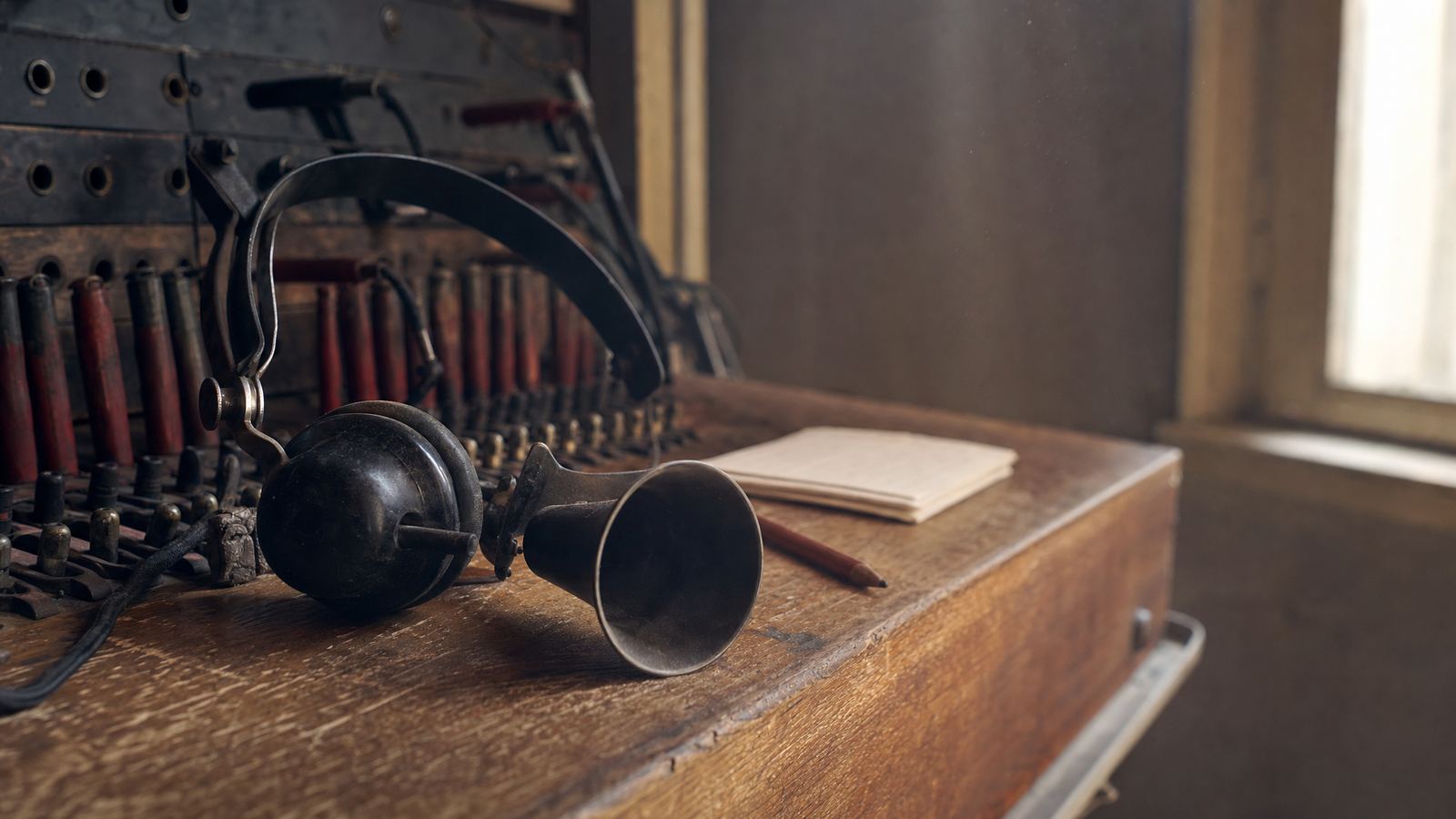
A manual switchboard is a wall of holes. Each jack stood for one line, and each had a tiny lamp beside it. Cords came up from the desk in pairs, weighted underneath so they slid back down when released. To connect two people the operator took the front cord of a pair, plugged it into the caller's jack, asked for the number, then plugged its partner into the jack of the person being called and rang through. On a busy evening she might have a dozen pairs up at once, crossing over each other in loops. The history of the telephone switchboard is mostly a history of making that wall larger and the reach across it shorter.
The boards grew because towns grew. A small exchange might hold a few hundred lines; a city exchange ran to whole rooms of operators seated shoulder to shoulder, each responsible for a section of the board, with supervisors walking the aisle behind them. The lamps did a lot of the work. A lit lamp meant someone was waiting, and a second lamp at the end of a cord told the operator when a conversation had ended and the pair could come down.
Listening as the whole job
What the job asked for most was attention. An operator heard a name, a number, an accent she had never met, a child who had picked up the receiver, a doctor in a hurry. She had a second or two to understand it and find the jack. Companies trained for a particular voice, calm and even, and for set phrases that cut down misunderstanding. "Number, please" was a formula for exactly that reason. It told the caller what to say next.
The work also carried a kind of local knowledge that never made it into a manual. In a small town, the operator knew which doctor was out on a call and where he had gone. She knew when the fire bell had rung and which line the volunteers would be calling. People asked her for the time, for the score of a game, for whether the train was late. Some of that was against the rules and all of it happened anyway, because the person at the board was the one point every call passed through.
When the listening moved into the machine
Automatic exchanges arrived early in the twentieth century and spread slowly, town by town. A rotary dial sends a run of electrical pulses for each digit, and a switch at the exchange counts them and steps along to the right line. The first time someone dials a call without speaking to anyone, the listening has moved out of a person and into a rack of relays.
That change was slow enough that many places kept operators for long-distance calls, for emergencies and for help long after local calls had gone automatic. Plenty of people over a certain age can still remember dialing zero and hearing a person answer.
What carried over
Much of what made a good operator still applies to anyone whose job is to pick up. A dispatcher on an emergency line, a nurse on a call-in line, a front desk clerk at a busy clinic: each has to hear the important part of what someone says while the rest of the room keeps going. The habits are the same ones taught at the board. Confirm what you heard. Ask one question at a time. Keep the voice level so the caller can match it.
The switchboard itself mostly disappeared into museums and the occasional old hotel basement. The idea of a single point where every call passes through a set of trained ears is harder to retire. Every time a phone menu asks you to say a few words about the reason for your call, someone has tried to rebuild it.